The Datadog-to-Elastic Migration That Costs 40-60% Less
(And Takes 12 Weeks, Not 6 Months)
Datadog works. But when your observability bill doubles in 6 months, you need an alternative that doesn't sacrifice visibility. We've migrated 15+ enterprises from Datadog to Elasticsearch -- zero downtime, 40-60% cost reduction, full feature validation.
Free assessment. See your TCO comparison, migration roadmap, and risk plan. 24-hour response.
See your 3-year cost comparison in 2 minutes.
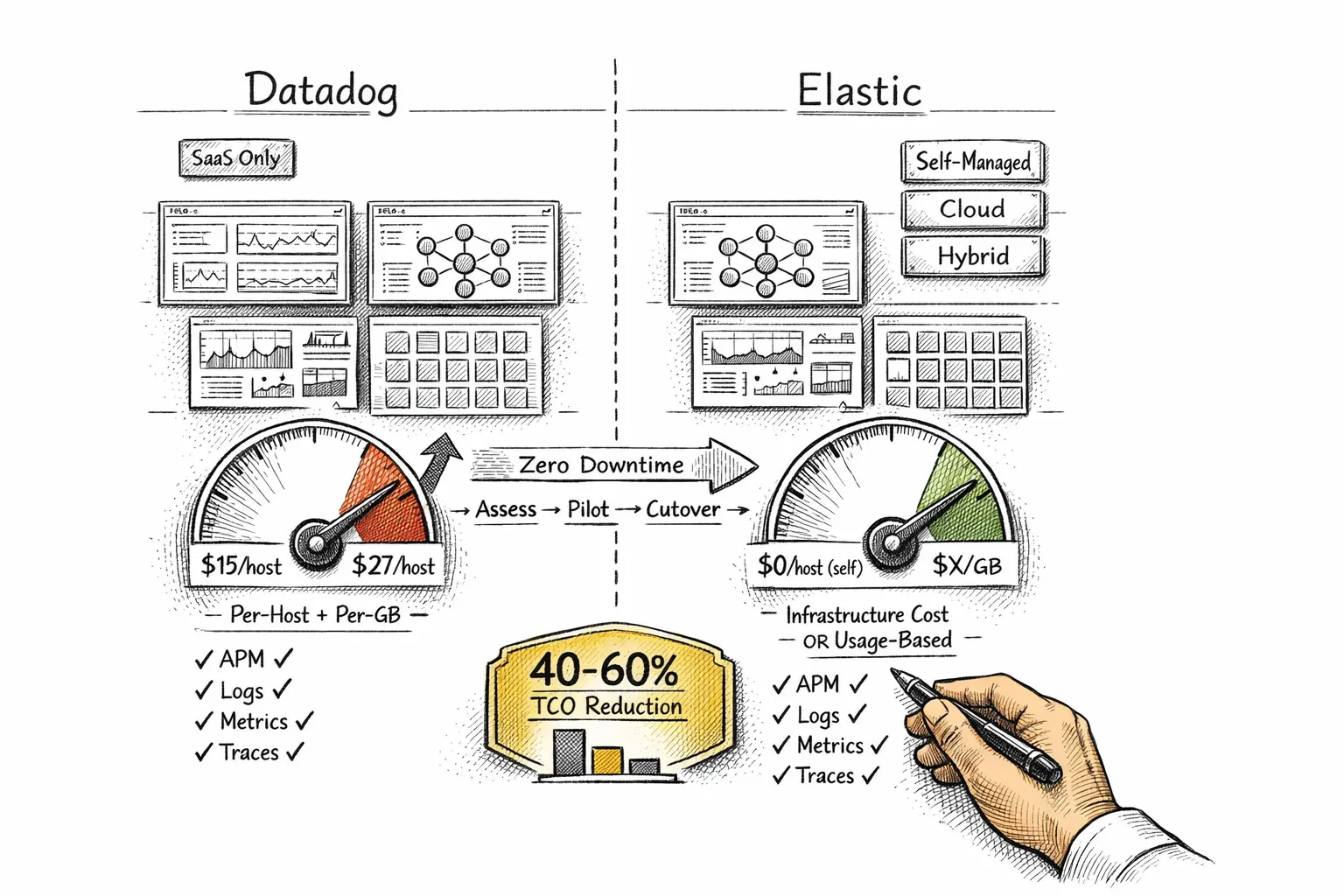
How Datadog and Elastic Compare
(And Why We Recommend Elastic for Cost-Conscious Teams)
Both are powerful observability platforms. Here's where they differ -- and where Elastic gives you options Datadog can't.
| Dimension | Datadog | Elastic |
|---|---|---|
| Pricing Model | Per-host + per-GB ingestion. Costs scale linearly. Add-ons increase bill 20-40%. | Self-managed: infrastructure cost only. Elastic Cloud: usage-based, not per-host. |
| Deployment | SaaS-only. No self-managed option. | Self-managed, Elastic Cloud (SaaS), or hybrid. You choose. |
| Data Ownership | Data on Datadog's multi-tenant infrastructure. Limited export. Vendor lock-in risk. | Self-managed = full data ownership. Your infrastructure, your data. Zero vendor lock-in. |
| Open Source | Proprietary. No source access. | Elasticsearch core is open-source (Apache 2.0 / SSPL). Inspect, modify, extend. |
| APM & Tracing | Best-in-class APM. OpenTelemetry support. Mature ecosystem. | Elastic APM with OpenTelemetry compatibility. 90% feature parity. |
| Log Management | Per-GB pricing for retention. Expensive at scale. | Elasticsearch-native. Tiered storage (hot/warm/cold) cuts retention costs 60-80%. |
| Infrastructure | Per-host metrics. Agent-based. | Metricbeat + Elastic Agent. Single agent for logs + metrics. |
| AI/LLM Obs | Limited. APM-based. Not topology-aware. | LLM Observability Platform (SquareShift). Purpose-built for GenAI. Production-ready. |
| Lock-In Risk | High. SaaS-only, proprietary format. | Low. Self-managed option. Open-source ecosystem. Data stays in your infra. |
| 3-Year TCO (1TB/day) | $800K-$1.2M | Self-managed: $300K-$500K. Cloud: $500K-$700K. |
Cost is the #1 reason teams evaluate Datadog alternatives
In our 15+ Datadog-to-Elastic migrations, 80% of teams cited cost as the primary motivator. The average result: 40-60% cost reduction over 3 years. Not promised. Achieved.
Calculate Your TCO SavingsHow We Achieve 40-60% Cost Reduction:
Datadog's Per-Host Model vs Elastic's Infrastructure-Only Pricing
Your Datadog bill grows linearly with every host you add and every byte you ingest. Here's the math -- and what changes when you switch to Elastic.
Datadog's Per-Host, Per-GB Model
How it works:
- Infrastructure Monitoring: $15-$27/host/month
- Log Management: $0.10/GB ingested + retention fees
- APM: $31-$40/host/month (Pro tier)
- Add-ons (RUM, Synthetics, Security): each adds 20-40%
Example: 100 hosts, 1TB/day logs, APM
- Infrastructure: $2,000/month
- Logs: $3,000/month
- APM: $3,500/month
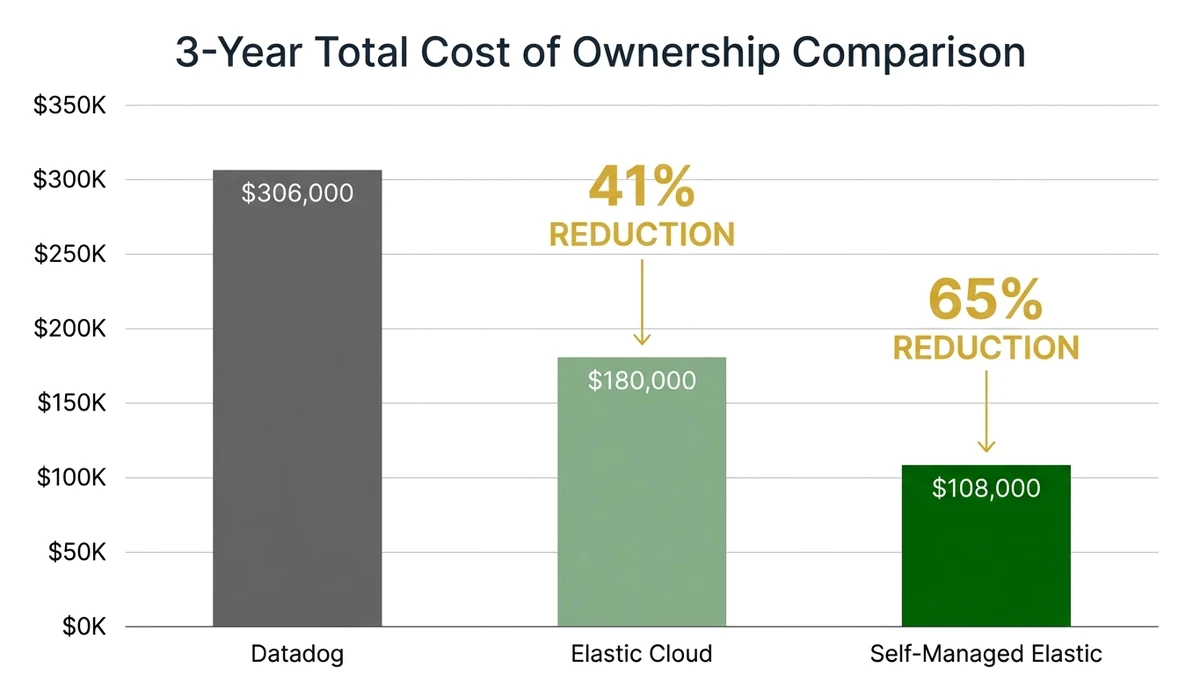
- Total: $8,500/month = $102K/year
At scale:
At 500 hosts + 5TB/day, annual Datadog bill reaches $400K-$600K. You pay per-host even when hosts sit idle 80% of the time.
Elastic's Self-Managed + Cloud Options
Self-Managed:
- Your AWS/GCP/Azure compute + storage
- Elasticsearch license: open-source (free) or Enterprise
- SquareShift services: implementation, optimization (optional)
Example: 100 hosts, 1TB/day, self-managed AWS
- AWS infrastructure: $2,500/month
- Elastic license: $500/month
- Total: $3,000/month = $36K/year
- Cost reduction vs Datadog: 65%
Elastic Cloud (SaaS):
- $5,000-$7,000/month for equivalent 1TB/day workload
- Total: $60K-$84K/year
- Cost reduction vs Datadog: 18-42%
At scale:
Self-managed costs grow with infrastructure only. You optimize instance types. You use reserved instances. You control the bill.
Your Observability Won't Gap During Migration
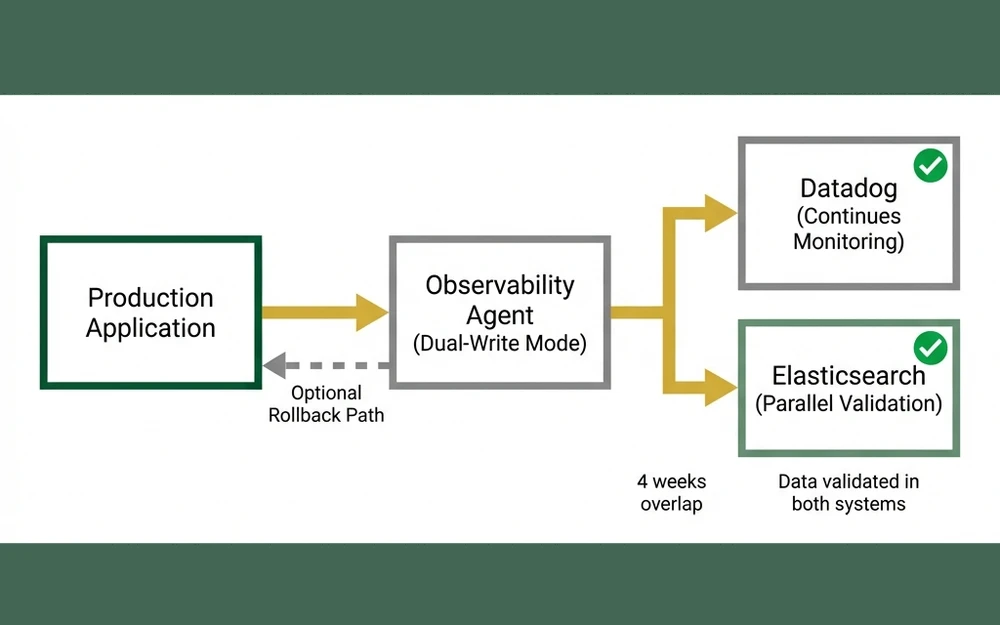
Worried about losing visibility mid-migration? Our dual-write architecture sends logs and metrics to both Datadog AND Elastic for the entire pilot and cutover phases. You validate Elastic works before you decommission anything. Zero observability gaps. Rollback ready at every phase.
See Our Migration Methodology3-Year TCO Comparison: 200 Hosts, 2TB/Day
Calculate Your Datadog vs Elastic TCO
Input your current Datadog environment. See your projected savings in 2 minutes.
Healthcare SaaS Platform: 58% Cost Reduction
Challenge: Datadog bill grew from $50K/year to $180K/year in 18 months. Per-host pricing made scaling expensive.
Solution: Migrated to self-managed Elasticsearch on AWS with SquareShift's zero-downtime dual-write methodology. Implemented index lifecycle management and tiered storage.
- 58% cost reduction ($180K/year to $75K/year)
- Zero downtime during 12-week migration
- 100% dashboard and alert parity
Feature-by-Feature: What You Keep, What You Gain
When Migrating to Elastic
Honest comparison. Datadog excels at some things. Elastic matches most and adds capabilities Datadog doesn't have. Here's the breakdown.
| Feature | Datadog | Elastic | SquareShift Assessment |
|---|---|---|---|
| Log Management | Best-in-class ingestion, search, analytics. Expensive at scale. | Elasticsearch-native logs. The core search engine many tools build on. | Feature parity. Elastic's Elasticsearch IS the engine. |
| Metrics | Per-host metrics. Agent-based collection. | Metricbeat + Elastic Agent. Single agent consolidates logs + metrics. | Feature parity. Fewer agents to manage. |
| APM & Tracing | Best-in-class APM. OpenTelemetry. Deep integration ecosystem. | Elastic APM. OpenTelemetry-compatible. Trace correlation with logs and metrics. | Datadog APM is more mature. Elastic covers 90% of use cases. We validate parity in pilot. |
| RUM | RUM for web and mobile. Mature mobile SDK. | Elastic RUM for browser and mobile. | Feature parity for web. Datadog mobile RUM is more mature. |
| Synthetics | Synthetic tests, API monitoring. Feature-rich. | Uptime monitoring via Heartbeat. Less mature. | Datadog synthetics stronger. Elastic covers basic uptime. We assess impact in pilot. |
| AI/LLM Obs | Limited. APM-based. Not topology-aware. | LLM Observability Platform (SquareShift). Purpose-built for GenAI. | SquareShift differentiator. Datadog APM not designed for LLM topology. |
| Alerting | ML-powered anomaly detection. Sophisticated rules. | Watcher alerting + ML anomaly detection. | Feature parity. Comparable ML anomaly detection. |
| Dashboards | Pre-built dashboards. Drag-and-drop. User-friendly. | Kibana dashboards. Canvas. More powerful, steeper learning curve. | Datadog easier to build. Kibana more powerful. Training included in migration. |
| Security | RBAC, SSO, audit logs. SOC2, HIPAA. | RBAC, SSO, audit logs. SOC2, HIPAA. Plus field-level security. | Feature parity. Elastic's field-level security is more granular. |
| Integrations | 450+ integrations. AWS, GCP, Azure, SaaS apps. | 300+ integrations. Cloud, Beats ecosystem, Logstash. | Datadog has more out-of-box. Elastic may require more configuration. |
| Data Retention | Retention costs scale linearly. $0.05-$0.10/GB archive. | Index lifecycle management. Tiered storage. $0.01/GB cold tier. | Elastic advantage. Tiered storage cuts retention costs 60-80%. |
AI/LLM Observability: A Differentiator Datadog Can't Match
Datadog APM traces LLM API calls. It doesn't understand LLM topology: model inputs, embeddings, vector search, re-ranking, generation, token consumption. Our LLM Observability Platform maps the full inference graph. Purpose-built on Elastic. Production-ready.
See LLM Observability DetailsLong-Term Retention Without Datadog's Retention Fees
Datadog charges $0.05-$0.10/GB for archive-tier retention. Elastic's index lifecycle management moves aging data to cold storage at $0.01/GB. For teams with 90-day compliance retention requirements, that's 60-80% savings on retention costs alone.
See Retention Cost ComparisonWhy LLM Observability Matters for GenAI Teams
(And Why We Built It on Elastic, Not Datadog)
The Problem: Datadog APM Was Not Built for LLM Topology
Traditional APM tools -- including Datadog's -- trace API calls. They see that your application called OpenAI's API and got a response in 340ms.
They don't see what happened inside the inference pipeline:
- Which embedding model processed the input
- How vector search retrieved context documents
- Whether re-ranking changed the result order
- What the token consumption looked like per request
- Whether the generated response met quality thresholds
- Whether PII leaked into the prompt or response
For teams running GenAI in production, these blind spots are the difference between observability and guessing.
3-Perspective LLM Observability Framework
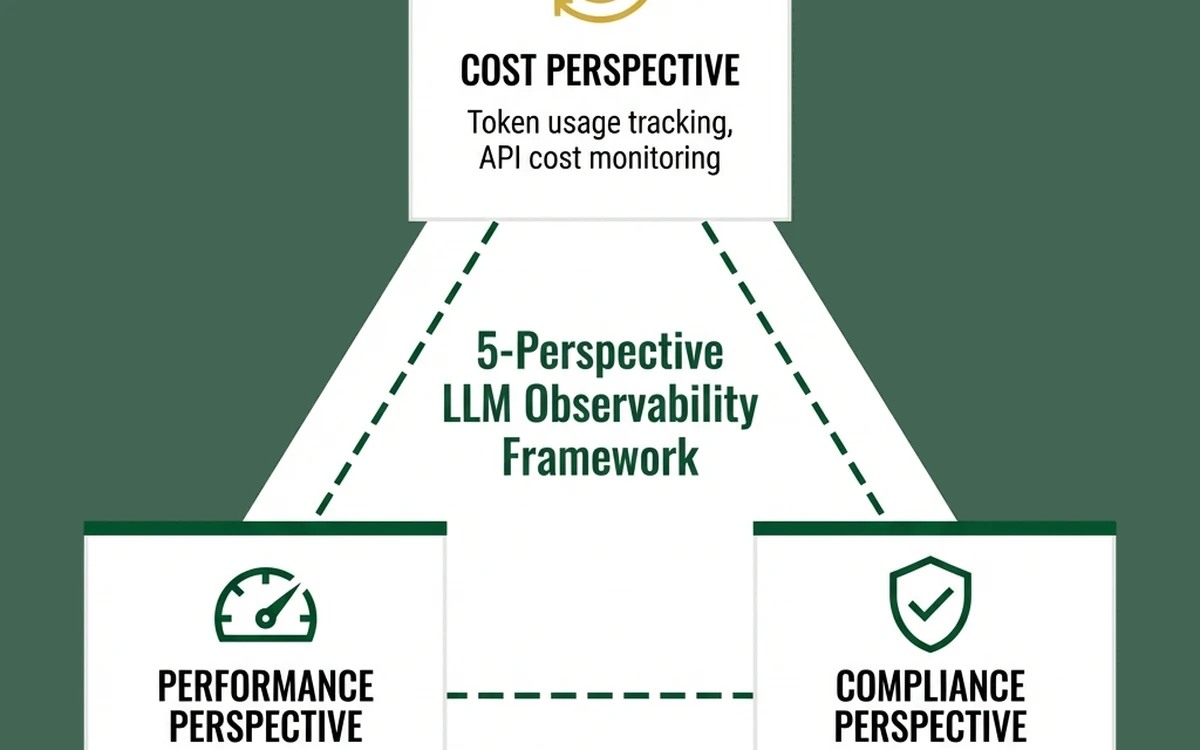
Cost Perspective
Track token consumption, API costs, and inference spend per request. Know exactly what each LLM call costs before your bill surprises you.
Performance Perspective
Monitor latency across the full inference pipeline: embedding generation, vector search, re-ranking, response generation. Identify bottlenecks at the layer level, not the API level.
Compliance Perspective
Detect PII in prompts and responses. Audit LLM interactions for regulatory compliance. Enforce data governance policies on LLM outputs.
Built on Elasticsearch. Deployed by SquareShift.
Full framework includes 5 perspectives (Cost, Performance, Compliance, Quality, Behavior). Simplified to 3 here for clarity. Full details on the LLM Observability Platform page.
"We were using Datadog APM to monitor our GenAI features. It showed us API latency. It didn't show us that our embedding model was consuming 4x the tokens we budgeted because of a prompt template change. SquareShift's LLM Obs Platform caught it in production within 2 hours."-- GenAI Engineering Lead, Healthcare SaaS Platform
Why We Recommend Self-Managed Elastic
(And When Elastic Cloud Makes Sense)
Datadog is SaaS-only. Elastic gives you deployment choice. Here's how we help you pick the right model.
Datadog: SaaS-Only
What it means:
Datadog hosts all infrastructure. Your data lives on Datadog's multi-tenant infrastructure (US or EU regions).
What's good:
- Fast setup. No infrastructure to provision.
- Zero ops burden. Datadog manages uptime, scaling, patching.
- Predictable SaaS experience.
What's limiting:
- No data ownership. If you leave, exporting data is painful.
- Limited data residency. US or EU only. No on-prem.
- No cost control. Per-host, per-GB with no way to optimize.
- Compliance gaps for HIPAA, FedRAMP, data sovereignty mandates.
Elastic: Self-Managed, Cloud, or Hybrid
Option 1: Self-Managed Elasticsearch
- Deploy on your AWS, GCP, Azure, or on-prem infrastructure.
- Full data ownership. Logs never leave your environment.
- Cost control: choose instance types, reserved instances, spot pricing.
- Data residency: deploy anywhere. On-prem, private cloud, air-gapped.
- Compliance: HIPAA, FedRAMP, SOC2.
Option 2: Elastic Cloud (SaaS)
- Elastic-hosted SaaS. Similar convenience to Datadog.
- 14+ regions including GovCloud.
- Usage-based pricing (not per-host).
Option 3: Hybrid
Critical workloads on-prem. Less-sensitive workloads on Elastic Cloud. Best of both: data sovereignty where it matters, SaaS convenience where it doesn't.
Our recommendation:
Self-managed delivers the largest savings (40-65% vs Datadog). Elastic Cloud still saves 18-42% with less management overhead.
BFSI Enterprise: 100% Compliance, 45% Cost Reduction
Challenge: Datadog SaaS didn't meet data residency requirements. On-prem mandate for PII logs.
Solution: Deployed self-managed Elasticsearch in private cloud with SquareShift's architecture guidance. Full data ownership. Zero data egress.
- 100% compliance with data residency policy
- 45% cost reduction vs Datadog
- 12-week deployment, assessment to production
Our 4-Phase Zero-Downtime Migration Methodology
(12 Weeks from Assessment to Datadog Decommission)
15+ Datadog-to-Elastic migrations completed. Zero production downtime. Here's the methodology.
Phase 1: Assess & Plan
What happens:
- Audit current Datadog configuration: agents, integrations, dashboards, alerts
- Map every Datadog feature to its Elastic equivalent
- Calculate TCO comparison (your actual numbers, not estimates)
- Identify migration risks: custom dashboards, complex alerting, non-standard integrations
Deliverables:
- Migration assessment report
- TCO comparison spreadsheet
- Migration roadmap with timeline, milestones, risk register
- Go/no-go decision point
Phase 2: Pilot & Validate (Dual-Write Architecture)
What happens:
- Deploy Elastic pilot environment
- Activate dual-write: logs and metrics flow to BOTH Datadog AND Elastic simultaneously
- Migrate critical dashboards, alerts, and integrations to Elastic
- Validate feature parity: side-by-side comparison
- Performance testing: ingest rates, query latency, retention behavior
Both platforms receive identical data. You compare side-by-side. If Elastic doesn't match, we fix it before touching production. If something goes wrong, Datadog is still running. Nothing breaks.
Deliverables:
- Elastic pilot deployment
- Dashboard and alert migration proof (side-by-side validation)
- Performance benchmarks
- Go-live approval from your team
Phase 3: Production Migration
What happens:
- Gradual production cutover: agent-by-agent or service-by-service
- Dual-write continues throughout
- Monitor both platforms for discrepancies
- Rollback plan tested and ready at every stage
- Zero-downtime guarantee: observability stays live throughout
Deliverables:
- Production Elastic deployment
- Dual-write validation reports
- Incident response runbook
- Tested rollback plan
Phase 4: Optimize & Decommission Datadog
What happens:
- Optimize Elastic: index lifecycle management, tiered storage, cost tuning
- Decommission Datadog agents (after 2-4 weeks of stable Elastic)
- Final cost validation: actual spend vs projected
- Knowledge transfer: training on Elasticsearch, Kibana, alerting
Deliverables:
- Cost optimization report (actual vs projected savings)
- Training documentation and runbooks
- Post-migration support plan
- Your Datadog contract can now expire
Zero-Downtime Guarantee: How We Mitigate Migration Risks
Risk: Data Loss
Dual-write architecture sends logs and metrics to both platforms. Data validation checks at every phase. If data doesn't match, we stop and fix before proceeding.
Risk: Dashboard & Alert Gaps
Dashboard migration toolkit (automated Datadog-to-Kibana conversion). Manual migration with validation for complex dashboards. You approve every dashboard before cutover.
Risk: Performance Degradation
Load testing in pilot phase. Performance benchmarks validated against your production requirements before cutover.
Risk: Skill Gap
Training included in every migration: Elasticsearch fundamentals, Kibana dashboards, alerting. Or choose managed services -- we operate Elastic for you.
Free assessment. 24-hour response. Migration roadmap, TCO comparison, risk plan.
What Makes SquareShift Different:
Zero-Downtime, AI-Native, Cost-Validated
We've migrated 15+ enterprises from Datadog to Elasticsearch. Here's what separates us from other Elastic consultancies.
Zero-Downtime Track Record
15+ Datadog-to-Elastic migrations completed with zero production downtime. Our dual-write methodology keeps both platforms receiving data throughout. Largest migration: 2.4TB of observability data. Rollback plan tested at every phase.
Most consultancies require 4-6 hour cutover windows. We don't. Our dual-write methodology means your team never goes blind.
Cost Optimization Expertise
Average 40-60% cost reduction achieved across 15+ migrations. Not estimated. Validated. Every migration includes a post-migration cost report comparing actual Elastic spend to your previous Datadog spend.
Many consultancies estimate savings but don't deliver post-migration cost validation reports. We do. You see the real numbers.
AI-Native Observability
LLM Observability Platform is purpose-built for GenAI workloads on Elasticsearch. Topology-aware monitoring across the full inference pipeline: embeddings, vector search, re-ranking, generation, token consumption. Production-ready. Not bolt-on APM.
Competitors position 'AI' as implementation methodology. We build AI observability technology. Our LLM Obs Platform monitors the inference pipeline itself.
Managed Services Option
Post-migration, SquareShift offers managed Elastic services. 24/7 coverage. SLA-backed. We handle scaling, patching, upgrades, monitoring, and incident response. Your team focuses on building product, not managing infrastructure.
Most consultancies exit after implementation. We provide ongoing operations. 24/7 coverage across SFBA, Singapore, and Chennai.
15+ Datadog Migrations We've Completed:
Healthcare, BFSI, E-commerce
Real migrations. Quantified outcomes. Zero marketing fluff.
Healthcare SaaS Platform
Challenge:
Datadog bill grew from $50K/year to $180K/year in 18 months. Per-host pricing made scaling expensive. Data residency options needed for compliance.
Solution:
Migrated to self-managed Elasticsearch on AWS using zero-downtime dual-write methodology. Index lifecycle management and tiered storage.
- 58% cost reduction ($180K to $75K/year)
- Zero downtime, 12-week migration
- 100% feature parity
BFSI Enterprise
Challenge:
Datadog SaaS didn't meet data residency requirements. On-prem mandate for PII logs. Needed full observability without sending data to a third-party SaaS provider.
Solution:
Deployed self-managed Elasticsearch in private cloud. Full data ownership. Zero data egress to third parties.
- 100% compliance with data residency
- 45% cost reduction vs Datadog
- 12-week deployment
E-commerce Platform
Challenge:
Datadog APM + Log Management cost $15K/month. 90-day compliance log retention added $5K/month. Needed cost control without sacrificing coverage.
Solution:
Migrated to Elastic Cloud (SaaS for simplicity). Tiered storage for 90-day retention (hot to warm to cold).
- 42% cost reduction ($20K to $11.6K/month)
- 90-day retention at 1/3 the cost
- 6-week migration
Your Datadog Migration Questions, Answered
We've heard these questions from every team evaluating Datadog alternatives. Direct answers backed by 15+ completed migrations.
For most observability use cases, Elastic provides 90% feature parity with Datadog. Logs, metrics, APM, distributed tracing, alerting, dashboards -- covered.
Where Datadog has an edge (synthetics, some integrations), we assess impact during pilot phase before you commit. Our methodology includes dashboard and alert migration validation: you see exactly what translates before production cutover.
Healthcare SaaS case study achieved 100% feature parity -- every Datadog dashboard and alert replicated in Kibana.
View Healthcare Case StudyMigration cost (SquareShift services + Elastic deployment) is typically recouped within the first year through Datadog savings.
Example: A $50K migration engagement paired with $100K/year in Datadog savings means 6-month payback. After that, savings compound year over year.
Our Migration Assessment includes a full TCO comparison: migration cost + 3-year Elastic TCO vs 3-year Datadog spend. You see every line item before you commit.
Calculate Your TCOYes. Our dual-write methodology sends logs and metrics to both Datadog AND Elastic simultaneously during migration. Your observability coverage doesn't gap for a single minute.
15+ zero-downtime migrations completed, including a 2.4TB migration. Rollback plan tested at every phase. If something doesn't validate, we revert to Datadog and investigate -- your team never goes blind.
See Migration MethodologySelf-managed Elasticsearch gives you deployment flexibility Datadog cannot match. Your data stays in your infrastructure -- on-prem, private cloud, air-gapped environments. Full data ownership. Zero data egress to third parties.
Elastic Cloud offers 14+ regions including GovCloud for teams that want SaaS convenience with broader residency options than Datadog.
Our BFSI case study deployed self-managed Elasticsearch in private cloud and achieved 100% compliance with data residency policy.
View BFSI Case StudyThere is a learning curve for Kibana dashboards and Elasticsearch query language. We don't minimize that.
SquareShift includes training in every migration engagement: Elasticsearch fundamentals, Kibana dashboard building, alerting setup, and operational runbooks. Your team is productive on Elastic by the end of migration.
If you don't want the ops burden at all, our managed services option means we run Elastic for you -- 24/7 coverage, SLA-backed, across SFBA, Singapore, and Chennai.
Learn About Managed ServicesTypical timeline: 12-16 weeks from assessment to Datadog decommission.
Smaller deployments (under 50 hosts) can complete in 6-8 weeks. Our E-commerce case study migrated in 6 weeks using Elastic Cloud.
Larger environments (500+ hosts, custom integrations) may take 16-20 weeks. Our Migration Assessment provides a detailed timeline based on your specific environment. We respond to assessment requests within 24 hours.
View E-commerce Case StudyStill have questions? Talk to someone who's done this.
Book a Consultation24-hour response. No sales pitch -- just answers from engineers who've completed 15+ Datadog migrations.
Ready to Get Your Datadog Migration Roadmap?
(We Respond in 24 Hours)
Free Datadog-to-Elastic Migration Assessment. See your TCO comparison, migration timeline, feature gap analysis, and risk mitigation plan. No commitment. No sales pitch. Just the data you need to make the call.
Free assessment. 24-hour response guaranteed. | See your 3-year cost comparison in 2 minutes.
We respond to all migration inquiries within 24 hours. SquareShift operates around the clock: SFBA, Singapore, Chennai. Contact us directly